


Monomorium floricola
Monomorium floricola
SKU:
3 in stock
Couldn't load pickup availability


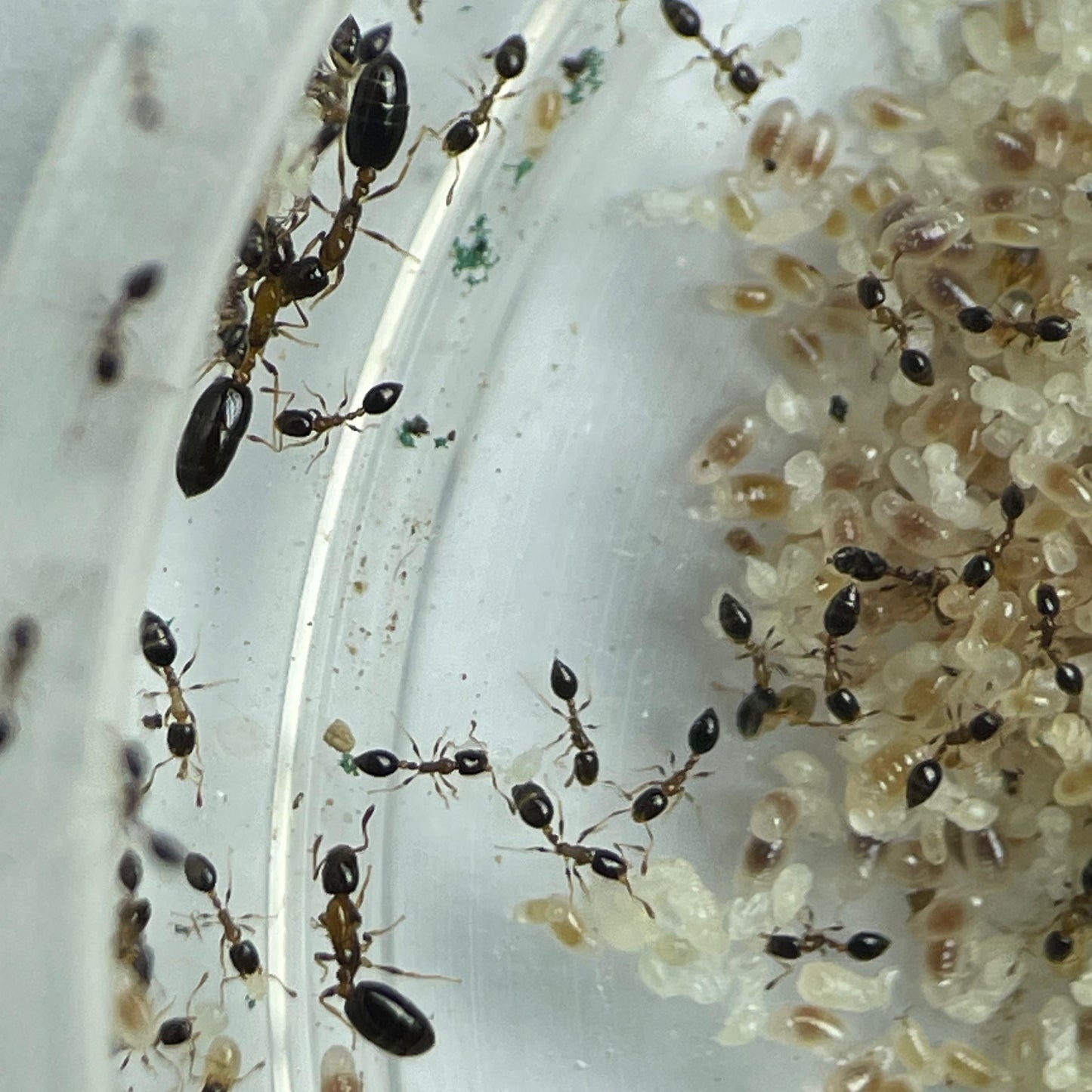
Description
Name: Monomorium floricola
Origin: Tropical and subtropical regions worldwide (likely originally from Africa/Asia, now globally distributed)
Queen: approx. 4 – 5 mm
Workers: approx. 1.5 – 2 mm
Food: carbohydrates (e.g. honey, sugar water), protein (insects such as fruit flies, small roaches, chopped crickets)
Humidity:
• Arena: 50 – 70 %
• Nest: 60 – 80 %
Temperature:
• Arena: 24 – 30 °C
• Nest: 24 – 28 °C
Winter Dormancy: No
Nest Type: Small 3D-printed nests, acrylic nests with moisture chambers, or finely structured aerated concrete (Ytong) are very well suited – completely escape-proof!
Colony Size: several thousand up to over 10,000 workers possible
Advantages and disadvantages of Monomorium floricola
Advantages:
Monomorium floricola is a very small, extremely active species with fast colony development. It is excellent for compact setups and shows interesting social behaviour. Thanks to its size, it can also be kept in smaller setups with a high number of workers.
Disadvantages:
Due to its extremely small size, it is highly prone to escaping. The tiniest gaps are enough to escape through – perfect sealing and escape-proofing (e.g. PTFE) is essential. In addition, the colony can grow very quickly under optimal conditions.
Care
Monomorium floricola is a tropical species and needs constant warmth as well as elevated humidity.
During the founding phase, a small test tube with an arena is suitable. Very good escape-proofing is important, as even young colonies can escape through the tiniest gaps.
Later, a moist, well-ventilated 3D-printed or acrylic nest with an arena of at least 20×20 cm is recommended. Due to their strong growth, expansion space should be planned for early on.
This species is active day and night and constantly foraging – ideal for keepers who want to observe constant movement in the formicarium.
Feeding
Very food-active – especially at warm temperatures.
• Offer protein such as fruit flies, small roaches, or chopped crickets every 2–3 days
• Provide carbohydrates such as sugar water or honey permanently – change regularly to avoid fermentation
At higher temperatures, food demand increases significantly. Cleanliness is especially important, as leftover food can mould quickly in humid conditions.